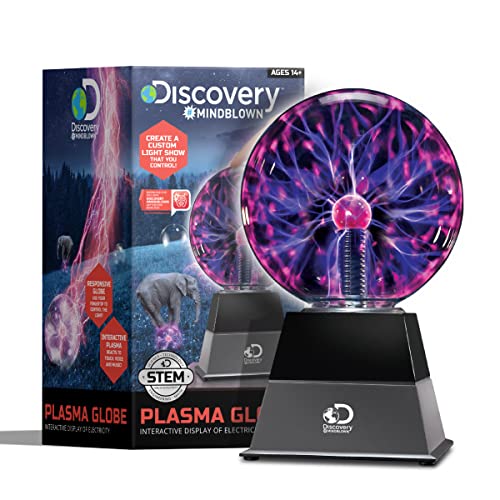
A plug-in plasma globe from Discovery. Touch the glass and the purple and pink streams of light follow your fingers; a built-in sound sensor makes them move to voices or music. The listing explains the science: a Tesla coil at the center sends current through noble gases. For a physical science or physics teacher, it is a ready-made hook for lessons on electricity, gases and states of matter, and students will line up to touch it. It runs on the included 12V adapter. The listing rates it for ages 14 and up and warns against metal surfaces and wet hands, so it belongs on the teacher's desk, not passed around a sixth-grade room.
Pros
- Instant lesson hook
- Touch and sound reactive
- Plugs in, no batteries
Cons
- Rated 14 and up
- Keep away from metal surfaces
Best for: physics and physical science classrooms
A large Newton's cradle with seven 20 mm steel balls hung from 8 mm chromed bars on a beech base. Pull back one ball and one flies out the other side; pull back two and two fly out. It is the standard desk demo for conservation of momentum and energy, and a physics teacher can use it to open the unit or leave it out for students to test their predictions. The listing claims more than 50 seconds of swing and a one-year warranty that covers replacement balls and strings. Cradles need the strings adjusted if they get tangled in a busy room, so it does best on the teacher's desk.
Pros
- Classic momentum demo
- Large steel balls swing for a long time
- Warranty covers strings and balls
Cons
- Strings can tangle if students handle it roughly
Best for: momentum and energy units
A 7.5-inch tube with a metal electrode on each end. Hold one end in each hand and it lights up and makes a sound; let go and it stops. The trick lies in completing the circuit with your body, which makes open and closed circuits concrete for a class. Have students hold hands in a line and the whole row becomes the wire. The included guide covers conductors and insulators. Steve Spangler Science designs it for classrooms, and the listing says it is safe to touch with bare hands. It costs about as much as a lunch, so a coworker or a student can give it, and an elementary or middle school science teacher will use it the next week.
Pros
- Whole-class human circuit
- Activity guide included
- Cheap enough for any giver
Cons
- One stick per circuit, so big groups share
Best for: circuits and electricity lessons
A 2-megapixel USB microscope on a flexible arm stand, magnifying 60x to 250x with an adjustable LED ring light. It works as a standard webcam, so it runs on Windows, Mac, ChromeOS and Linux without special drivers, and it comes with USB and USB-C connectors. In a science room the point is simple: plug it into the laptop on the projector and every student sees the onion cell, the insect wing or the crystal at once, instead of waiting in line at one eyepiece. It will not replace a compound microscope at high magnification, but it covers most of what a middle school or biology class looks at in a demo.
Pros
- Shows a specimen to the whole class
- Works on almost any computer
- Flexible stand and adjustable light
Cons
- Lower magnification than a lab microscope
Best for: biology and life science teachers
A 444-piece molecular model kit with 136 atoms in standard colors, 158 bonds and 150 extra parts to build a carbon-60 fullerene. It builds both ball-and-stick and space-filling models, which helps when a chemistry class moves from bond angles to molecular size. A teacher can build methane and water at the front of the room or hand pieces out to lab groups. Chemistry teachers often run short of model parts by spring, since pieces disappear, so a second kit gets used. The pieces are small and easy to lose, and it is a better fit for high school chemistry than an elementary room.
Pros
- Two model styles in one box
- Enough pieces to share with groups
- Builds a fullerene for a showpiece
Best for: chemistry teachers
National Geographic's rock collection holds 200 genuine rock, mineral and crystal specimens, including amethyst, pyrite, rose quartz and tiger's eye, plus two geodes to break open, a magnifying glass, a color learning guide and a storage bag. An earth science teacher can sort the specimens into station bins for an identification lab or hand them out during a rocks unit. The geodes make a good end-of-unit moment. Many specimens are small tumbled pieces, so this suits handling and sorting more than a display case. For the price, it gives a classroom a lot of material, and it works as a gift from a family or a coworker.
Pros
- 200 specimens for stations
- Geodes to break open
- Learning guide included
Best for: earth science teachers
Sam Kean's The Disappearing Spoon tells true stories behind the elements of the periodic table: rivalries, poisonings, wars and odd discoveries. The title comes from gallium, which melts in a hot cup of tea, a story chemistry teachers like to retell. A chemistry or physical science teacher will find a dozen openers for class in it, and it reads well over a summer break. It is a paperback that costs about as much as a lunch, which makes it an easy coworker gift. A teacher who reads popular science may already own it, so ask first or add a gift receipt.
Pros
- Stories to retell in class
- Easy summer read
- Low-cost gift
Cons
- Popular, so some teachers already own it
Best for: chemistry teachers who like a good story
A 16-ounce clear borosilicate glass mug shaped like a lab beaker, with a handle, standard and metric measuring marks and the caffeine molecule printed on the side. The joke works because every science teacher spends the year telling students never to eat or drink from lab glassware. The listing says it is microwave safe and made of thicker glass. It is a gift that a student, a parent or a coworker can give for the price of lunch, and it will sit on the desk all year. Clear glass shows coffee stains, so it needs a proper wash, and glass breaks more easily than a ceramic mug.
Pros
- Instant lab joke
- Measuring marks for tea and coffee
- Microwave safe
Cons
- Glass is more fragile than ceramic
Best for: chemistry teachers
A small round self-inking stamp from ExcelMark that prints Checked By and the teacher's name or initials, with a 5/8-inch impression. Science teachers check a lot of paper that needs a mark rather than a grade: lab notebooks, safety contracts, pre-lab questions and homework completion. A stamp is faster than initials and harder for a student to fake. The listing says the pad lasts thousands of impressions. It is the most practical of the personalized gifts here, and it suits a coworker or a parent who wants to give something used every day. Allow a few days for the seller to make it, and spell the name the way the teacher signs.
Pros
- Faster than initialing every page
- Hard to fake
- Thousands of impressions
Cons
- Small impression
- Needs extra time to make
Best for: checking lab notebooks
EISCO's hand crank Van de Graaff stands 22 inches tall with a polished metal dome about 8 inches across, a 4-inch discharge sphere, a grounding wire and an experiment guide. The listing says it can build up to 100,000 volts in the right conditions, and the hand crank lets students see mechanical energy turn into electrical energy. It is the demo behind the photo of a student with hair standing on end. Many school budgets do not cover one, which makes it a strong group gift from a PTA or a science department. Static demos work poorly in humid weather, so expect the best results in the dry months. Follow the guide's safety notes.
Pros
- The demo students remember
- No power outlet needed
- Experiment guide included
Cons
- Weaker in humid weather
- Costs more than a coworker gift
Best for: physics and physical science teachers