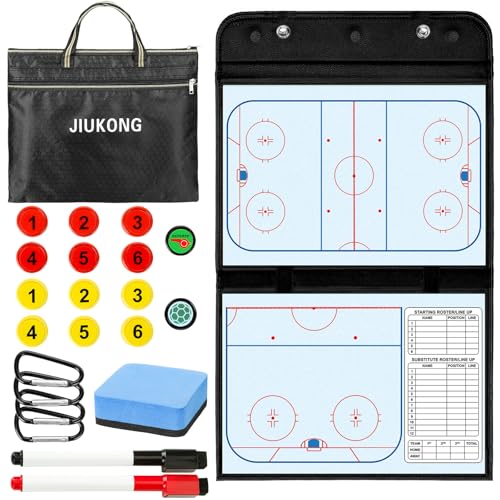
A two-sided magnetic board built for ice hockey. One side shows the full ice for game plans; the other zooms in on one zone for power plays, breakouts and defensive coverage. The kit includes 14 player magnets, two dry-erase markers, an eraser, four fence clips and a zippered carry bag. A coach can set the magnets for a forecheck before a shift and move them while the players watch, which beats drawing the same arrows twice. The bag keeps magnets from scattering across the bench. It is a tool for teaching between whistles, not a big wall board for the locker room, and dry-erase marker can smudge with wet gloves.
Pros
- Full-ice and zone sides
- Magnets, markers and clips included
- Zippered bag
Cons
- Small for a locker-room talk
- Marker smudges with wet gloves
Best for: head coaches who draw plays on the bench
The Fox 40 Classic is a pealess whistle mounted on a finger grip, so a coach can hold it on a gloved hand instead of digging for a lanyard. Fox 40 rates it at 115 decibels, loud enough to cut through a rink full of pucks hitting the boards. The pealess design has no moving parts, so nothing inside can freeze, jam or break, and the ABS plastic shrugs off moisture. Coaches who blow the whistle dozens of times a practice will like how fast it gets to the mouth. It is a small gift, best paired with a card or a bigger team present, and some coaches still prefer a lanyard.
Pros
- No pea to freeze
- Fits a gloved hand
- Loud over rink noise
Cons
- Small on its own
- Some coaches prefer a lanyard
Best for: coaches who run drills in gloves
Two rechargeable hand warmers, each 0.6 inch thick, that click together with magnets for double-sided heat or split up to go in two gloves or pockets. Three settings run at 104, 111 or 120 degrees, and the listing puts battery life at about three to eight hours per charge, depending on the level and the cold. A coach on the bench through a full game, or on an outdoor rink in January, gets warm hands without a pile of single-use packets. They charge between practices. Battery life drops on the highest setting, so a long tournament day may need a midday top-up, and they are a gift for winter, not for summer camps.
Pros
- Rechargeable, no waste
- Fits in a glove
- Three heat levels
Cons
- Shorter run time on high
- Needs charging between sessions
Best for: coaches who stand on a cold bench
A 24 ounce vacuum-insulated bottle from Thermos, a brand that has made them since 1904. The listing says it keeps drinks hot for 18 hours or cold for 24, so coffee poured at home for a 6 a.m. practice is still hot after the last drill. The push-button lid has a locking ring that seals it leak-proof in a hockey bag, and the vented wide lip makes hot coffee easier to sip. The outside stays cool to the touch and does not sweat. It is a plain, durable bottle that fits the job well. It does not fit under every coffee maker, and it is top-rack dishwasher safe only.
Pros
- Hot for 18 hours
- Locking leak-proof lid
- Trusted brand
Cons
- Plain design
- Top rack only in the dishwasher
Best for: coaches with early-morning ice times
A cube-shaped puck bag from CCM, one of the biggest names in hockey equipment. It holds up to 50 pucks, which covers most youth and high school practices, and the wide zipper opening makes it easy to dump the pucks on the ice and scoop them back after the last drill. The 600D polyester shell takes rough handling, and the adjustable, removable shoulder strap has a non-slip pad, which matters when 50 pucks weigh close to 20 pounds. Coaches who carry pucks in a bucket or an old duffel will use it the first week. It holds pucks only, so the coach still needs a separate bag for cones and boards.
Pros
- Holds up to 50 pucks
- Padded shoulder strap
- Mainstream hockey brand
Cons
- Pucks only, no extra pockets
- Heavy when full
Best for: coaches who bring the pucks to practice
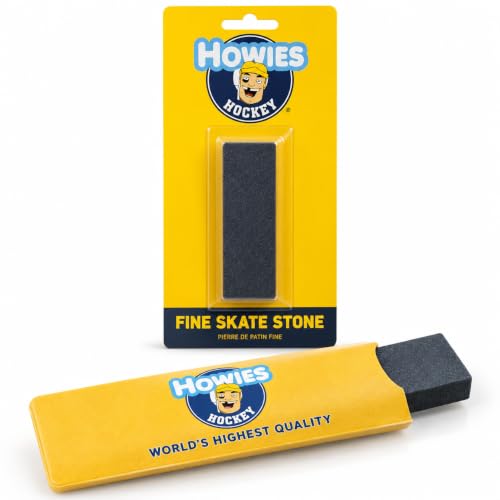
A small fine-grit stone made from silicon carbide for touching up skate blades. It does not replace a sharpening at the pro shop, but it takes out burrs and small nicks that a coach picks up stepping on a bench door or a rink-side screw. Coaches skate every practice, often on the same pair for years, and a stone in the bag saves a skate that suddenly grabs or slides. It also helps with players' skates on tournament weekends, when the pro shop is closed. It needs a light hand: too much pressure can round an edge, so a coach who has never used a stone should ask a sharpener first.
Pros
- Pocket size
- Fixes small nicks fast
- Useful on tournament weekends
Cons
- Not a full sharpening
- Takes some practice to use
Best for: coaches who skate every practice
Two Green Biscuit passers, the off-ice pucks built to slide on concrete, asphalt, basements and tennis courts. The listing says a 240-game NHL veteran invented them, and they are built for passing and stickhandling: one-touch passes, toe drags and saucer passes. A coach who runs dryland sessions before the season, or summer camps when the ice is out, can run real passing drills on a parking lot instead of using a bouncing ball. Players can also take one home for homework. The listing says plainly that these are not made for shooting, so a coach who wants shooting drills needs a different puck.
Pros
- Slides like a puck off the ice
- Good for dryland drills
- Pack of two
Cons
- Not for shooting
- Wears on rough asphalt
Best for: coaches who run dryland and summer sessions
A 14 ounce stoneware mug with a small hockey net built onto the side, hand-painted so each one looks a little different. The idea came from a kid named Max at age 8, and the family business behind it has won a Stevie Award and shows up on morning TV. A coach can flip marshmallows from a hot cocoa into the net, or just use it as a big coffee mug at the desk. It arrives gift-packaged, so a player can hand it over without wrapping, and it is dishwasher and microwave suitable. It is a novelty first: the net makes it awkward in a cup holder, and it costs more than a plain printed mug.
Pros
- Real laugh when opened
- Gift-packaged
- Large 14 ounce size
Cons
- Awkward in a cup holder
- Pricier than a printed mug
Best for: coaches with a sense of humor
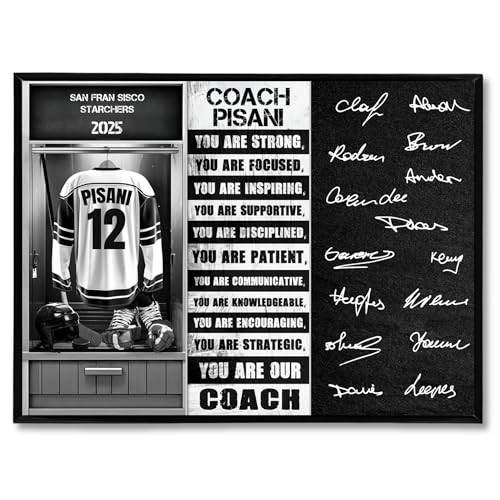
A custom plaque made to look like a locker room stall, with a jersey printed with the coach's name, number, team name and year. The whole team signs around it with the permanent silver marker that ships with every plaque. The frame is matte black on a solid wood base made in the U.S., and an optional easel lets it stand on a desk. It suits the end-of-season party, senior night or a coach's last year with a group. One parent should order it two to three weeks ahead, since custom printing takes time, and collect signatures at the last practice. It costs more than one family should spend, so it works best as a pooled team gift.
Pros
- Made for team signatures
- Marker included
- Name, number and year printed
Cons
- Needs lead time
- Best as a pooled gift
Best for: an end-of-season team gift
A clear puck case on a walnut-tone base with a laser-engraved, polished plate, from a family trophy company that has made awards since 1956. The plate can carry the date and score of a first win, a championship or a coach's last game, and the case holds any regulation puck. It is a cheap way to turn the game puck, often tossed to the coach after a big win, into something for the office shelf. Pair it with the game puck if the team kept one. The puck is not included, the case stands 5 1/4 inches tall, and engraving adds a few days, so order it before the banquet.
Pros
- Engraved plate
- Fits any regulation puck
- Small, desk-friendly
Cons
- Puck not included
- Engraving adds lead time
Best for: coaches who save game pucks