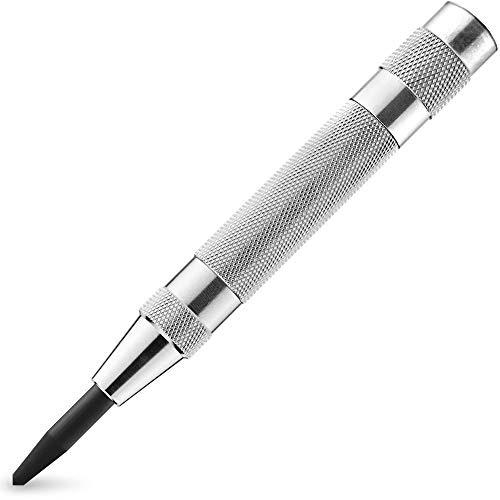
A 6-inch steel rule from Mitutoyo, the measuring-tool brand many machinists and engineers trust. The listing describes tempered stainless steel with a satin chrome finish that cuts glare, 4R graduations in 1/8, 1/16, 1/32 and 1/64 inch, and a body 3/64 inch thick and 3/4 inch wide. The Bureau of Labor Statistics says mechanical engineers build and test prototypes and visit worksites to deal with specific equipment problems, and a pocket rule is the first tool out on those trips. It is a small, serious gift that shows you know the job. It is not a caliper, so it will not replace precision measurement, and engineers who already carry a favorite rule may not switch.
Pros
- A trusted brand at a coworker price
- Glare-free satin chrome
- Fits a shirt pocket
Cons
- Inch graduations only
- Plain to unwrap
Best for: engineers who walk the shop floor
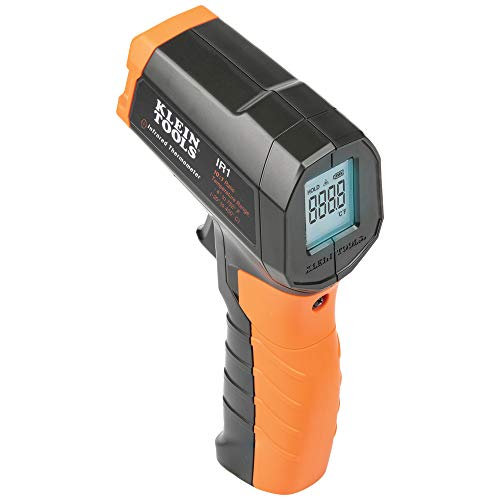
A pistol-grip infrared thermometer from Klein Tools that reads surface temperature from -4 to 752 degrees F. The listing gives a 10:1 distance-to-spot ratio, a targeting laser, a backlit display, auto-hold and fixed emissivity. Mechanical engineers investigate equipment failures, according to the Bureau of Labor Statistics, and heat is often the first clue: a bearing running hotter than its neighbor, a motor housing that should be cooler. A non-contact reading lets an engineer check from a safe distance. Fixed emissivity means shiny metal surfaces can read low, so a strip of tape or paint helps. It is a tool gift, not a toy, which is the point.
Pros
- Fast non-contact readings on equipment
- Laser shows where it reads
- Trusted tool brand
Cons
- Fixed emissivity misreads shiny metal
- More useful to plant engineers than CAD-only designers
Best for: engineers who troubleshoot equipment
The second edition of the Ultimate GD&T Pocket Guide, based on the 2018 version of the tolerancing standard according to its title. Geometric dimensioning and tolerancing tells a machinist and an inspector how much a part may deviate, and getting a symbol wrong on a drawing can scrap a batch. A pocket reference lets a design or quality engineer check a callout at the desk or on the shop floor in seconds. It is a modest gift, practical and specific, which mechanical engineers tend to value. Engineers who work to a different standard or revision should check before relying on it.
Pros
- Quick GD&T lookups at the desk or on the floor
- Pocket size
- Useful from the first week
Cons
- Tied to one standard revision
- Not exciting to unwrap
Best for: design and quality engineers
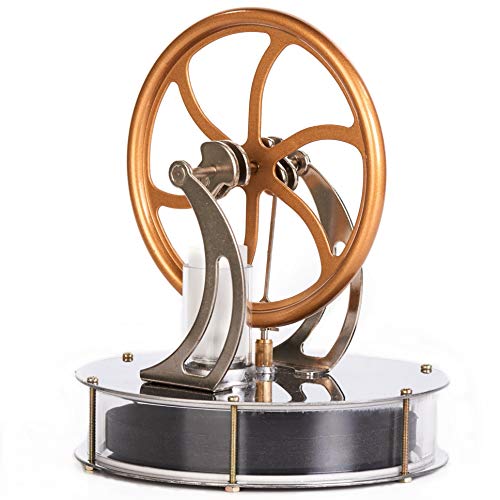
A small low-temperature Stirling engine on a flat base. The listing says to set it on a cup of hot coffee, and the temperature difference between the coffee and the room drives the piston and flywheel. When it slows, the coffee has cooled to drinking temperature. For a mechanical engineer, it is a thermodynamics textbook diagram that moves, and it sits on the desk as a conversation piece through every design review. It delights in the first week and keeps working after. It needs a hot surface to run, so it spends some time still.
Pros
- A working heat engine on a coffee cup
- Starts design-review conversations
- No batteries
Cons
- Runs only on a hot surface
- Delicate parts
Best for: anyone who passed thermodynamics
A metal precision gyroscope from Joytech with a laser-cut rotor. Wrap the drawstring around the shaft, pull, and the spinning rotor balances on the stand or a fingertip in ways that seem to ignore gravity. The listing pitches it as a teaching tool for physics, and that is what it is for a mechanical engineer: precession and angular momentum from the dynamics course, now on the desk. Colleagues will pick it up in every meeting. It needs a few tries to get a good spin, and the string can wear over time. Compared with cheaper plastic gyroscopes, the metal body spins longer and feels like a real instrument.
Pros
- Dynamics you can hold
- Metal rotor spins smoothly
- Fits a coworker budget
Cons
- Takes practice to spin well
- Drawstring wears out
Best for: engineers who loved dynamics class
A wind-up model of a watch tourbillon and escapement, 3D printed at a fine 0.1 mm layer height and assembled by hand, says the listing. Turn the winding wrench clockwise, nudge the gear and the whole movement starts ticking, with the escapement and gear train in full view. A tourbillon is one of the most admired mechanisms in watchmaking, and this oversized model lets a mechanical engineer study it without a loupe. It suits a desk or a shelf in a design office. Because each one is printed and assembled by hand, small layer lines are part of the look, and the plastic parts will not take rough handling.
Pros
- A famous mechanism at desk scale
- Fine print quality
- Wind-up, no batteries
Cons
- Plastic parts need gentle handling
- Visible print lines
Best for: engineers who love mechanisms
A reprint of 507 Mechanical Movements: Mechanisms and Devices, a catalog of gears, cams, linkages and other motion devices, each with a drawing and a short description. Mechanical engineers and makers use it as an idea book: flip through, find a way to turn rotary motion into linear, and adapt it. It suits a design engineer, a student or a retiree who builds in the garage. It is inexpensive and survives a lifetime on a shelf. The drawings come from an older era, so expect no modern materials or CAD, and the language reads like a nineteenth-century reference. That is part of the charm.
Pros
- Hundreds of mechanisms in one book
- Low price
- Useful for design ideas
Cons
- Old-fashioned language and drawings
- No modern components
Best for: mechanism designers
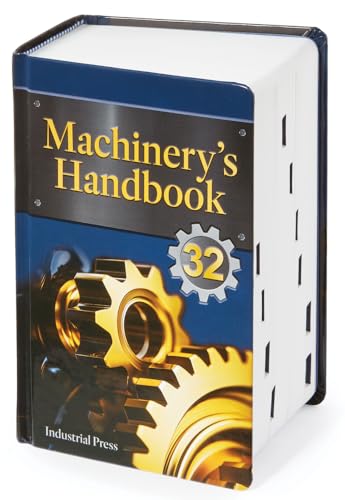
The Toolbox edition of Machinery's Handbook from Industrial Press. The handbook has been a standard reference for people who design and make mechanical parts for generations, a single book of shop data, standards and formulas. A mechanical engineer who spent college borrowing a copy from the lab will be glad to own one. The Toolbox edition is the compact format, sized for a workbench or a desk instead of a shelf. It makes a strong gift from family or a team for a promotion, a first design job or a PE license. The listing gives little detail about which edition number ships, so check if the engineer cares about having the latest one.
Pros
- The standard mechanical reference
- Compact Toolbox size
- Lasts a whole career
Cons
- Listing does not state the edition number
- Many engineers use online tables instead
Best for: a promotion or a new design job
A compact desktop 3D printer from Bambu Lab, bundled with an LED lamp kit to print as a first project. The listing promises full-auto calibration and quick setup, plus access to the MakerWorld model library and remote monitoring through the Bambu Handy app. Mechanical engineers build and test prototypes, says the Bureau of Labor Statistics, and a printer at home lets them test a bracket or a jig over the weekend instead of waiting for the shop. It is also a hobby that eats evenings in the best way. The A1 mini has a small build plate, so it suits parts and fixtures, not large assemblies. Filament is an ongoing cost.
Pros
- From CAD to part overnight
- Auto calibration for an easy start
- Lamp kit for a first project
Cons
- Small build volume
- Filament costs extra
Best for: an engineer who prototypes at home
A UGEARS wooden mechanical model of a 1920s-style Grand Prix race car. The listing describes a working V8 engine with 16 valves, a cooling fan, a hand crank starter and a visible drive, plus a three-mode transmission with idle, reverse and forward, spring suspension and rubberized wooden wheels. Every part snaps or slides together without glue. For a mechanical engineer, it is an engine and gearbox to build with their own hands over a weekend and then run on the desk. It suits family, or a team that wants a fun send-off gift. Some pieces are delicate, and patience helps, which most engineers have.
Pros
- Working engine and transmission
- Weekend-length build
- Looks good on a shelf afterward
Cons
- Delicate wooden parts
- Takes several hours to build
Best for: engineers who build for fun