A box of 72 white Fulltouch sticks from Hagoromo, the brand mathematicians have hoarded for years. The original Japanese maker stopped production in 2015, and a South Korean company has made the chalk under the same name since then. The listing describes a coated stick that keeps dust off the hands, a dense compression-molded body that wears down slowly, and foam slots that hold each stick so it arrives in one piece. For a professor who writes proofs across three boards a lecture, that is the daily tool. The gift only works if the department still has chalkboards. A teacher with whiteboards will smile and put it in a drawer, so ask first.
Pros
- The chalk with a following among mathematicians
- 72 sticks last a long time
- Arrives unbroken in foam slots
Cons
- Useless in a whiteboard-only room
- Plain box, so add a card
Best for: professors and teachers who still lecture at a chalkboard
A small glass whiteboard that sits on the desk between keyboard and monitor, sloped so it is comfortable to write on. The listing gives the size as 15.8 by 7.1 inches, includes four markers and an eraser, and adds a drawer underneath for the markers. Most mathematicians and statisticians work in offices, according to the Bureau of Labor Statistics, and many of them still reach for something to write on when a model stops making sense. A board in arm's reach beats a stack of scrap paper. The surface is small, so it suits a few lines of algebra or a diagram, not a full proof. It also works as a keyboard shelf when nobody is writing.
Pros
- Fits the space between keyboard and monitor
- Glass wipes clean without ghosting
- Markers and eraser included
Cons
- Room for a few lines, not a full proof
- Takes some desk depth
Best for: statisticians and quants who sketch between screens
A 0.5 mm mechanical pencil with Uni's lead-rotation gear, which turns the lead slightly each time it touches paper. The listing says this keeps lines fine and even instead of wearing a flat edge on one side. The body is all metal with a blasted grip, and a resin damper in the tip absorbs the small movements that make cheap pencils feel loose. For someone who writes subscripts, primes and summation limits all day, a consistent fine line makes the page easier to read later. It feels like a small upgrade, not a novelty. People who press hard may break 0.5 mm lead now and then, and the pencil weighs more than a plastic one.
Pros
- Point stays sharp through long notation
- Solid metal body
- Useful from the first page
Cons
- 0.5 mm lead snaps under heavy pressure
- Heavier than a plastic pencil
Best for: proof writers who work in pencil
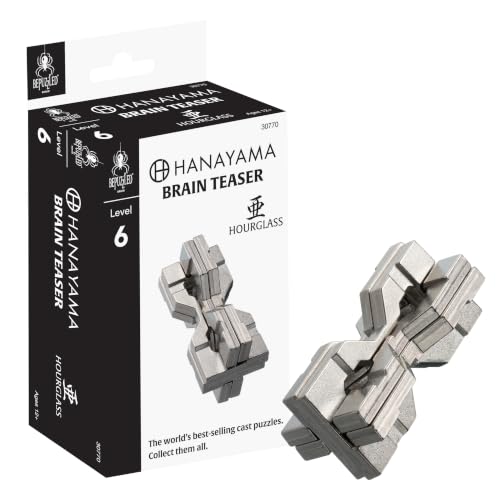
A two-piece cast metal puzzle from Hanayama, sold through BePuzzled and rated level 6 on the Mensa scale the brand uses. The task is to separate the two halves of the hourglass and put them back together. It suits mathematicians because it is a closed problem with a clean answer and no instructions, the same itch a good exercise scratches. It sits on a desk as an object, and colleagues will pick it up during office hours. Level 6 is hard. Someone who dislikes being stuck for a week may give up and look for the solution online, which ruins it. The listing does not say whether a solution sheet is included.
Pros
- Hard, with a clean solution
- Metal, built to last
- Looks good on a desk
Cons
- Can frustrate for days
- Small for the price
Best for: a hard puzzle for a desk drawer
A round wooden puzzle of stacked, rotating dials. The goal, per the listing: turn the layers until each of the 12 columns adds up to 42. Holes in the upper dials reveal or hide numbers below, so a move that fixes one column breaks another. The brand rates it expert level, 5 out of 5. A mathematician will want to reason about it before spinning anything, which is the fun. It doubles as an object on a shelf, with a Greek-style design that looks better than most desk toys. Once solved, it has less replay value than a card game. Pass it along to the next colleague, or leave it in the classroom for students.
Pros
- Arithmetic puzzle with a real constraint
- Good-looking wooden object
- Works for teachers and students too
Cons
- Low replay once solved
- Bulky for a small desk
Best for: math teachers and professors with office hours
Texas Instruments' financial calculator, with keys for time value of money, amortization, NPV and IRR on uneven cash flows, and one- and two-variable statistics with four regression types. The Society of Actuaries lists the BA II Plus among the few calculators allowed in its exams, and candidates may bring more than one approved model, so a spare helps on exam day. The Bureau of Labor Statistics notes that associate-level certification can take up to seven years of exams. That is a lot of practice problems on one keypad. The gift is narrow. A pure mathematician or a teacher has no use for it, and an experienced fellow already owns two.
Pros
- On the SOA's approved calculator list
- Handles TVM, cash flows and statistics
- A backup for exam day
Cons
- Only useful to actuarial and finance candidates
- Many candidates already own one
Best for: actuarial students studying for exams
A plain coffee mug printed with the line "A mathematician is a device for turning coffee into theorems." The line comes from the Hungarian mathematician Alfréd Rényi and is often credited to Paul Erdős, so most mathematicians will get it before they finish reading. That recognition is the gift. It costs about what a Secret Santa allows, and it gets used every morning. The listing gives few details beyond the slogan, so do not expect a heavy designer mug. A mathematician who already owns three math mugs may not need a fourth. In that case, pair it with the mug warmer or a bag of good coffee.
Pros
- The joke every mathematician knows
- Fits a Secret Santa budget
- Used daily
Cons
- Few listing details on size or finish
- Math mugs are a common gift
Best for: the department coffee drinker
A baking pan in the shape of the Greek letter pi, with the same volume as a typical 9-inch pie pan, says the listing. It exists for one purpose: Pi Day in March, which the U.S. House of Representatives supported in a 2009 resolution that urged schools to mark the day. A math teacher who bakes will put it to use that week, and a professor can bring a pi-shaped pie to the department seminar. It is the most photographed gift on this list. It is also a baking pan, so it only works for someone who bakes, and it sits in a cupboard the other eleven months.
Pros
- Pure delight on Pi Day
- Standard 9-inch pie volume
- Great for teachers who bake
Cons
- Only for people who bake
- Seasonal, one day a year
Best for: Pi Day in a math department
A Klein bottle in clear, handmade borosilicate glass, about 8 inches tall and 4 inches across. The listing has fun with it: zero volume, one-sided, nonorientable, locally Euclidean, does not work as a mousetrap. A true Klein bottle needs four dimensions, so any glass one is a three-dimensional model with a self-intersection, which is exactly the conversation a mathematician will want to have with visitors. It turns a topology lecture into a shelf object. It is fragile, and it serves no practical purpose. That makes it a family or team gift, not something one coworker should spend this much on.
Pros
- A real topology object, handmade in glass
- Starts a conversation in any office
- Fun listing written for math people
Best for: topologists and anyone who teaches geometry
Amazon's 11-inch e-ink tablet for reading and handwriting. The listing describes a textured, paper-like screen, a pen that never needs charging and has a built-in eraser, a notebook for handwritten notes and support for documents and books, in a body 5.4 mm thin and 400 g light. For a mathematician who prints papers to annotate them and fills pads with scratch work, it replaces a stack of both. It does not replace a chalkboard, and some people never warm to writing on glass. At this price it is a family or team gift. Check that the recipient wants a dedicated device, since some already use a tablet for the same job.
Pros
- Reads papers and takes handwritten notes
- Pen needs no charging
- Light enough to carry to seminars
Cons
- Writing on a screen does not suit everyone
- Family or team price
Best for: a mathematician who reads papers and writes by hand