Netter's Anatomy Flash Cards turn the illustrations from the Netter atlas into a portable deck. The Bureau of Labor Statistics describes the first phase of medical school as classrooms, small groups and laboratories, with anatomy at the top of the course list, and that is the year these cards earn their keep. A student can run a few cards in line for coffee, before a lab practical or on the bus home. The deck works best as a gift for a first-year student in the fall, before the anatomy block ends. Second- and third-years who already passed anatomy will get less out of it. The listing gives no card count, so we cannot say how many structures the deck covers. Check the edition before you buy, since Elsevier updates the series.
Pros
- Uses the Netter drawings students already study
- Portable review between lectures
Cons
- Little use after the anatomy block
- Listing gives no card count
Best for: first-year students in gross anatomy
The Rocketbook Core is a spiral notebook with reusable pages. A student writes with the Pilot Frixion pen that comes in the box, scans the page with the Rocketbook app into Google Drive, Dropbox or OneNote, and wipes it clean with a damp cloth. Medical students redraw the same diagrams many times before an exam: the clotting cascade, the brachial plexus, the Krebs cycle. A notebook they can wipe and reuse fits that habit better than a stack of printer paper. The letter size gives room for a full pathway on one page. Two limits: the pages need the Frixion pen or a compatible one, and a student who takes all notes on a tablet may not switch back to paper.
Pros
- Pages wipe clean for the next round of review
- Scans notes to the cloud apps students already use
Cons
- Needs Frixion-type pens
- Tablet-only note takers may not use it
Best for: students who sketch pathways by hand
This small cube starts a countdown when a student flips it so the chosen time faces up. The listing gives 11 presets from 1 to 90 minutes, three alert modes (beep, vibrate and mute) and a USB-C battery. Medical students spend much of the preclinical years and the months before USMLE Step 1 in long, timed study sessions, and a timer that is not the phone keeps them off the phone. The vibrate mode suits a quiet library. The cube is about the size of a matchbox, so it also rides along in a backpack. A student who already uses an app timer may not change habits, and the fixed presets do not allow odd times such as 40 minutes.
Pros
- Flip to start, no buttons
- Vibrate mode for quiet libraries
- USB-C charging, no batteries
Cons
- Fixed preset times only
- Easy to lose in a bag
Best for: students who study in timed blocks
The Maxwell Quick Medical Reference is a small spiral guide that lives in a white coat pocket. The listing names it as the pocket edition, 7th edition, and gives no other detail, so we keep this review to what we know: it is small, it costs less than a lunch out, and it is built for a pocket. The American Medical Association notes that core clerkships run about four to eight weeks at many schools, and the second half of medical school moves students from lectures to patients. That is the moment a pocket reference helps, when a resident asks a question on rounds and there is no time to open a laptop. It makes a good gift from an upperclassman or a classmate before third year. A student who already owns one will not need a second.
Pros
- Fits a white coat pocket
- Classic first-rotation gift
- Low cost for a classmate
Cons
- Listing gives few details on contents
- Duplicates what a student may already own
Best for: third-years starting clinical rotations
A Tromner hammer is the reflex hammer with two heads, a large mallet for the knee and a small one for the biceps and smaller tendons. This ADC model has a chrome head, latex-free silicone mallets and a brush that screws into the handle for sensory testing. It is 8.5 inches long and carries a one-year warranty. The Bureau of Labor Statistics describes the second phase of medical school as working with patients under supervision in hospitals and clinics, and a student on that phase needs a hammer of their own instead of borrowing the one in the clinic drawer. The gift works best before third year or before a neurology rotation. Students who prefer the lighter Taylor triangle hammer may find the Tromner heavier in a pocket.
Pros
- Two mallet sizes in one tool
- Hidden brush for sensory exams
- Latex-free
Cons
- Heavier than a Taylor hammer
- Some schools hand out a basic hammer
Best for: students on neurology and internal medicine rotations
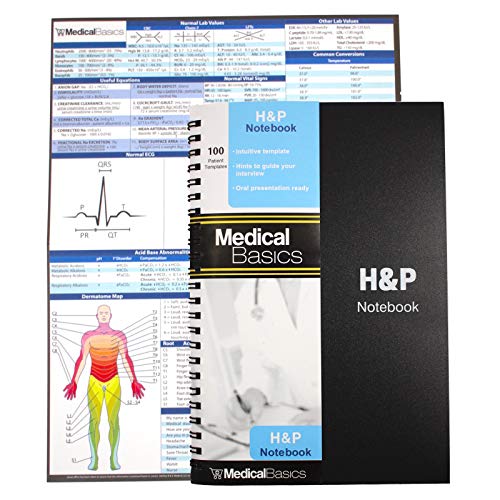
The H&P notebook gives a third-year student 100 printed templates for the history and physical, the note students write for nearly every new patient. Each template spreads across two facing pages, the pages tear out along perforations, and a reference sheet comes with the book. The listing says medical students designed it, and at 8.5 by 5.5 inches it fits the pocket of a white coat or scrubs. On a busy admitting day, a template keeps a student from missing a section when a resident asks for the social history. The book suits the first months of clerkships most. By fourth year many students write notes straight into the electronic record, and some schools discourage paper notes with patient details, so the student should follow the hospital's privacy rules on what goes on paper.
Pros
- 100 templates in pocket size
- Tear-out pages
- Designed for students
Cons
- Less useful once notes move to the EHR
- Hospital privacy rules limit paper notes
Best for: third-years writing their first H&Ps
The Manta Original is a blackout sleep mask with two molded eye cups that slide along the strap. A student can move the cups to fit the face so light does not leak in at the nose, and the cups do not press on the eyes. The listing names shift work and daytime sleep as uses and says the whole mask is machine washable in a mesh bag. On rotations the schedule follows the patients, as the American Medical Association puts it, so a student on surgery may sleep at 8 p.m. and one on nights may sleep at noon. A mask that blocks a sunny bedroom makes those hours count. The fit takes a few nights to adjust. Side sleepers may prefer a flatter mask, since the listing names back and belly sleepers.
Pros
- Adjustable cups block light well
- No pressure on the eyes
- Machine washable
Cons
- Bulky for side sleepers
- Fit takes some adjusting
Best for: students on surgery and night-float rotations
The Doctor Loading mug puts a progress bar and the student's name on a ceramic mug. The seller prints it on both sides in the USA, and the listing says it is safe in the dishwasher and microwave. The joke fits the long road. The Bureau of Labor Statistics counts four years of medical school after college, then a residency of three to nine years before a doctor practices alone. Classmates, study partners and parents all get the reference. A named mug also keeps it from walking off in a shared apartment or a student lounge. The seller needs the name before printing, so order a week or two ahead of a birthday or exam. The design is busy, and a student with plain taste may keep it at home.
Pros
- Custom name keeps it from walking off
- Dishwasher and microwave safe
- Joke every med student gets
Cons
- Needs lead time for printing
- Busy design
Best for: classmates and study partners
Pocket Medicine is the internal medicine handbook from Massachusetts General Hospital, published by Lippincott Williams & Wilkins. The listing names the book and the publisher and little else, so we will not quote page counts or edition details here. The title tells you the job it does: a pocket handbook of internal medicine for the first year of residency, the training stage that the Bureau of Labor Statistics says lasts three to nine years depending on the specialty. For a graduation gift, it suits a new doctor heading into internal medicine, family medicine or a transitional year. A graduate going into surgery, psychiatry or radiology will use it less. Check the edition on the product page before you buy, because a newer one may exist.
Pros
- Written for internal medicine
- Pocket size for the white coat
Cons
- Less useful outside medicine specialties
- Check the edition before buying
Best for: graduates starting internal medicine residency
The Cross Click is a slim click-action ballpoint in polished chrome. Dayspring Pens engraves up to 30 characters below the clip, enough for a name and MD or a graduation date, and ships it in a Cross gift box. The listing says the Click is slimmer and lighter than the Cross Century, so it fits a scrubs or white coat pocket, and it takes standard Cross ballpoint refills. A graduate will carry it from match day into intern year, where pens disappear by the dozen. That is the risk too: an engraved pen is easier to lose on a busy ward than to replace. Family or a group of classmates can give it, and the engraving makes it feel like a keepsake from medical school.
Pros
- Engraved with name and title
- Slim enough for a scrubs pocket
- Arrives in a gift box
Cons
- Easy to lose on the wards
- Engraving adds lead time
Best for: graduates who want a keepsake they can use